

Industrial IoT – Data Collection and Analysis for Modern Manufacturing
Digital transformation in manufacturing is impossible without data. And the Industrial Internet of Things (IIoT) is the technology that turns that data into a strategic advantage. IIoT connects sensors, devices, applications, and networks into a single intelligent ecosystem capable of collecting, analyzing, and evaluating data from the entire production environment in real time. The result is manufacturing that is more efficient, flexible, and sustainably competitive.
What does the abbreviation IoT mean?
Internet of Things (IoT) refers to a network of devices that communicate with each other via the internet. In everyday life, we encounter it in the form of smart homes or wearable devices that collect data about our health. IoT enables the collection, transmission, and monitoring of data from the surrounding environment, followed by automation — all without any manual intervention.
Portfolio
- SCADA/MES – Production Process Management
- Industrial IoT – Data Collection and Analysis
- Building and Data Center Monitoring
- Predictive Maintenance and OEE Monitoring
- Digitalization/Optimization of Manufacturing Processes
- Reporting and Business Intelligence
- High Performance HMI Interface design
- Energy Consumption Monitoring
- Connecting Enterprise Systems, Databases and SAP ERP
- Consulting / Advisory
What is Industrial IoT (IIoT)?
Industrial IoT (IIoT) is the industrial extension of the IoT concept. It is a complex ecosystem of sensors, devices, applications, and network components that continuously collect, transmit, and monitor data from production technologies. This data is then analyzed, evaluated, and used to improve the efficiency, flexibility, and competitiveness of manufacturing processes.
In practice, IIoT becomes a fundamental pillar of Industry 4.0 because it enables companies to:
- collect data and monitor equipment status in real time,
- digitalize and automate production control,
- measure and evaluate the efficiency of production equipment,
- prevent failures through predictive maintenance,
- optimize energy consumption and monitor/manage buildings,
- and integrate production data with enterprise systems (ERP, BI, and others).
IoT / IIoT Architecture
Every IoT / IIoT solution is built on a specific architecture — a logical structure of layers that work together to collect, transmit, and process data. At IoT Industries, we use a proven model consisting of four main layers:
Sensor Layer (Edge Layer)
This layer includes sensors, IoT modules, and PLC devices that collect data from machines, production lines, or buildings (e.g., vibration, temperature, energy consumption, environment, output quality, process parameters, movement, position, safety status, and maintenance conditions).
Communication Layer (Network Layer)
Responsible for reliable and secure data transmission using protocols such as OPC UA, MQTT, or Modbus. It also includes encrypted communication, network segmentation, and access control to ensure maximum cybersecurity.
Platform Layer
The core of digital manufacturing is the Industrial IoT platform, capable of collecting, storing, analyzing, and visualizing data. At IoT Industries, we use the Ignition platform — a solution with an unlimited licensing model, open architecture, and seamless integration with other systems.
Application Layer
This layer provides clear dashboards, visualizations, trend analyses, automated alerts, predictions, modeling, and reports, enabling managers to react quickly to changes and make decisions based on accurate data.
IIoT Cycle in Practice – 4 Steps to Success
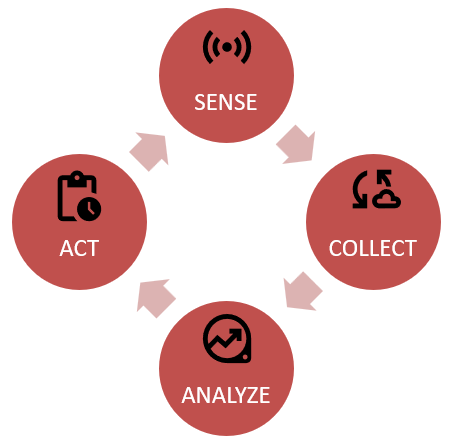
A successful IIoT implementation is built on a cyclical four-step process that ensures continuous improvement of manufacturing operations:
- Selection and deployment of IIoT sensors
- Connectivity and data collection
- Monitoring, analysis, and data evaluation
- Action and implementation of improvements
This cycle repeats over and over. IIoT is therefore not a one-time project, but an ongoing process of optimization and advancement.
What are the benefits of Industrial IoT?
✅ Increased productivity and efficiency – Real-time monitoring enables immediate reaction to any deviations, minimizing unplanned downtime and financial losses.
✅ Reduced costs – Optimized energy consumption, better planning, and automated production control contribute to long-term, sustainable cost reduction.
✅ Confident, data-driven decision-making – Data is collected automatically, giving managers constant access to accurate, up-to-date information for critical decisions.
✅ Scalable growth – The solution can be expanded with additional sensors, modules, reports, analyses, or notifications as the company grows.
Integrating IIoT with Other Systems
The true potential of Industrial IoT becomes fully visible when it is integrated with other technologies within the Industry 4.0 ecosystem. This creates a connected environment that unifies production, maintenance, energy management, and business operations into one intelligent whole:
- MES – digitalization of production processes
- SCADA – monitoring and control of production equipment
- OEE – measurement of overall equipment effectiveness
- CMMS – predictive and planned maintenance
- EMS/BMS – energy management and building automation
- Business Intelligence – clear data analysis and reporting
Successful IIoT implementation requires experience in connecting operational technology (OT) with information systems (IT). At IoT Industries, we bring more than technology to each project — we bring a strategic perspective on the entire data lifecycle.
Our solution includes system architecture design and sensor selection, secure connectivity and standardized data transmission, integration with MES, SCADA, OEE, CMMS, EMS/BMS, and BI systems, creation of real-time dashboards and reports, long-term support and future scalability of the solution.
Contact us and discover how Industrial IoT can transform your company into the intelligent manufacturing operation of the future.
I’d like to get a free quotation
Request a free consultation, and we will propose an effective, tailored solution for you.
