
Machines are running, employees are busy, yet production targets are still not being met. One workstation is waiting for materials, elsewhere the maintenance team learns about a breakdown too late, and management receives information about downtime only when it is too late to respond. Repeated delays put pressure on delivery deadlines, costs, and business competitiveness. If similar situations keep occurring in your facility, manufacturing process automation could be the solution. First, however, you need to identify exactly where the problems arise.
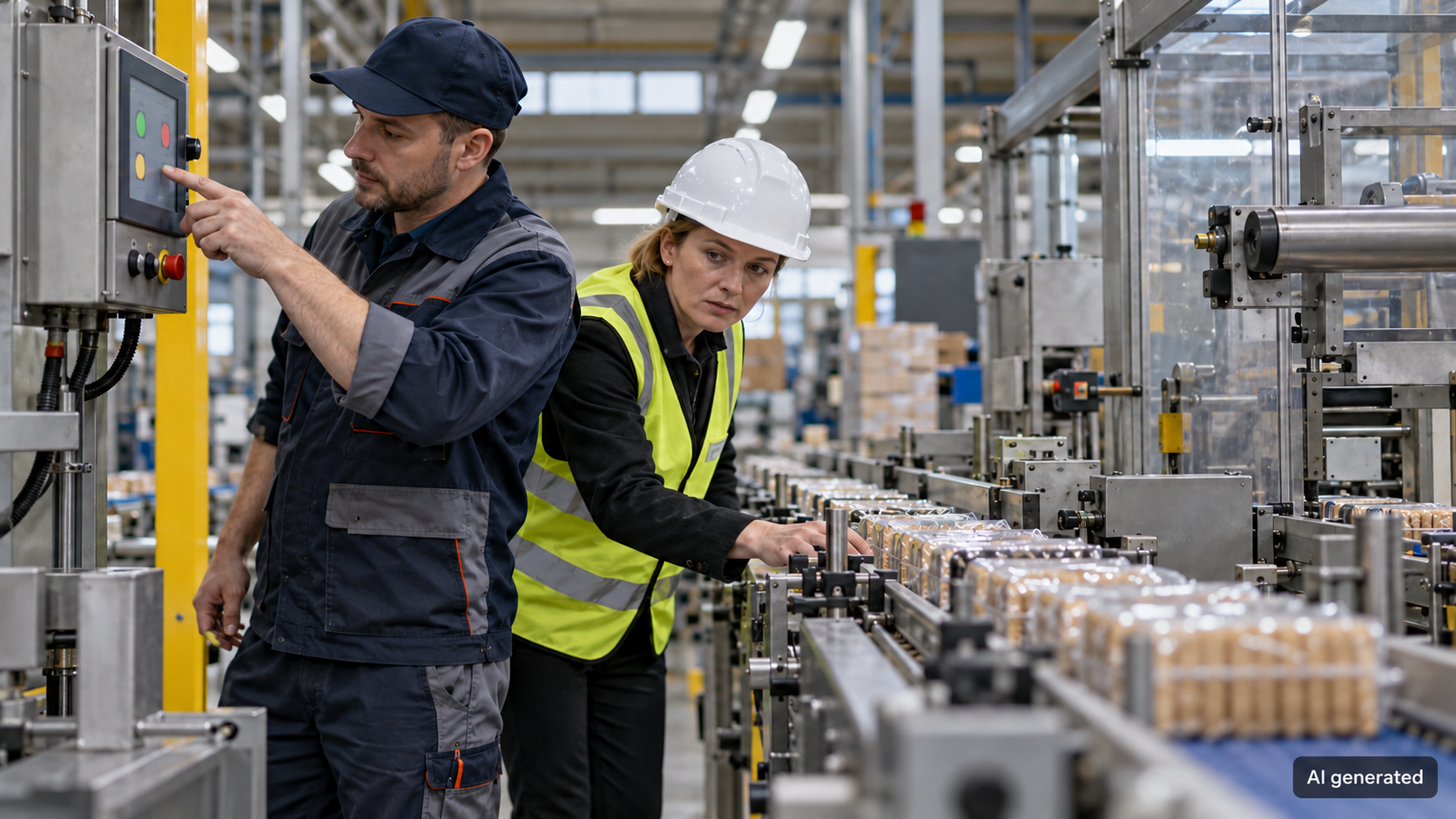
What does manufacturing look like when processes are not integrated?
Manufacturing operations without process automation do not necessarily look outdated. They may have modern production lines, high-quality machines, and experienced employees. The difference often becomes apparent only when examining how information flows between workstations. Individual workstations often operate as separate units. Information does not flow smoothly between them, and employees must repeatedly look it up, confirm it, or enter it into systems. Although each of these steps may seem insignificant, together they begin to create significant losses.
What does manufacturing process automation mean in practice?
Manufacturing process automation involves implementing technologies that transfer information, perform manufacturing operations, or trigger subsequent activities based on predefined rules, without requiring a person to manually initiate every individual step. It can involve a single operation or the coordination of multiple workstations. The level of human involvement varies. Sometimes the system performs an entire step independently, while in other cases it prepares information and leaves the decision to an employee.
Where can automation deliver the greatest benefits?
Data collection and alerts
Manufacturing process automation can begin with the collection of production data. The system retrieves data directly from machines and other equipment, eliminating the need for employees to record it manually and then re-enter it into other systems. Information about production status becomes available sooner, the risk of errors during data entry is reduced, and the system can automatically alert responsible personnel to selected events. The collected data also helps identify other recurring problems in production.
Integrating production with planning
The transfer of information between production planning and manufacturing workstations can also be automated. Current production instructions are transferred directly from the enterprise system to the shop floor, while information about production progress and results is automatically sent back to planners. They can see how individual orders are actually progressing and adjust the plan in time if necessary. This allows companies to plan production capacity more realistically, identify potential delays earlier, and meet delivery deadlines more reliably.
Control of selected operations
Process automation can also take over the control of repetitive manufacturing operations. The system monitors the necessary data from equipment and starts, stops, or adjusts individual steps according to predefined rules without constant employee intervention. This helps reduce demanding manual work, maintain stable production processes, and improve repeatability. If a deviation occurs, the system can stop the process and alert operators so that the problem can be addressed before it affects subsequent production.
How should process automation be implemented?
Start with the problem
Process automation should begin with identifying the problem, not selecting the technology. Choose a problem that occurs frequently and has a measurable impact on production. Then map how the entire process currently works and establish a baseline. How often does the problem occur? How much work, time, or money does it cost? And what impact does it have on production results? This information will allow you to assess whether the proposed automation has delivered an improvement.
Continue with a technical analysis
Only once it is clear which problem you want to solve and how you will measure the results should you proceed with a technical analysis. What data do existing machines already provide? What data is still missing? How can we obtain it reliably? Many companies hesitate to automate processes because they have older equipment in their production facilities. However, older machines do not necessarily present a problem. It is simply necessary to verify the connectivity options of each specific machine to ensure that the proposed solution works reliably without disrupting production.
Prepare a pilot project
Based on the technical analysis, a pilot project can be designed. Before launching it, define what success will look like. Then test the pilot during normal operations, including changes to production plans and situations requiring employee intervention. Also monitor whether the solution eliminates one manual task only to create another. This will help determine whether it works technically, makes employees’ work easier, and delivers measurable improvements. Only then does it make sense to decide whether to expand it to additional workstations.
Implement, evaluate, and optimize
If the pilot confirms both technical functionality and practical benefits, the solution can gradually be expanded to additional workstations. However, process automation does not end there. The new system generates additional data that may reveal problems the company was previously unaware of. Manufacturing automation thus gradually becomes a continuous improvement process. Data reveals a problem, the company takes corrective action, and can then immediately monitor whether it has delivered the expected result.
What specific benefits can automation deliver?
✅ Automation helps reduce errors by minimizing manual tasks and ensuring more consistent processes and more accurate data processing.
✅ It also increases productivity. When individual steps are better coordinated and problems are detected early, companies can make more efficient use of machines and working time.
✅ Greater efficiency can then translate into lower costs. Companies reduce losses and gain better visibility into opportunities for further savings.
✅ Management gains a more accurate and up-to-date picture of production performance. This enables better-informed decisions about priorities, capacity utilization, and future investments.
✅ The combination of reliability, higher productivity, better cost control, and improved decision-making ultimately strengthens the company’s overall competitiveness.
Discover where automation can deliver results for your manufacturing operations
Manufacturing process automation is not a one-size-fits-all solution. Every company uses different technologies and production methods and faces different challenges. That is why the first step is to map the specific process, available data, and areas where errors, time losses, or unnecessary costs currently occur. Only then can a solution be designed and its potential benefits assessed against the company’s needs.
If you want to find out which processes in your manufacturing operations have the greatest potential for automation, schedule a no-obligation consultation with us. Together, we will analyze your current operations, assess the capabilities of your existing equipment and systems, and propose the next steps with a clearly defined objective. This will give you a concrete basis for deciding which processes are worth automating and what results you can realistically expect from the project.
Why Choose IoT/IIoT Implementation with IoT Industries?
Traditional companies typically specialize in OT (operational technologies, such as production lines and devices) or classic enterprise IT systems. However, we are able to connect both of these worlds. Our unique expertise in integrating OT and IT allows us to deliver innovative solutions in digital transformation, enhancing efficiency, reliability, and competitiveness for manufacturing companies.
