
Most manufacturing companies today still manage their processes through a “rear-view mirror.” They deal with problems that happened yesterday, analyze downtime that occurred last week, and make important business decisions based on incomplete and delayed data. If you manage a modern production environment, you know that the pressure to increase productivity and reduce costs is relentless. And this is exactly where Industry 4.0 comes into play. A strategic tool that helps transform data into performance, transparency into control, and technology into real results.
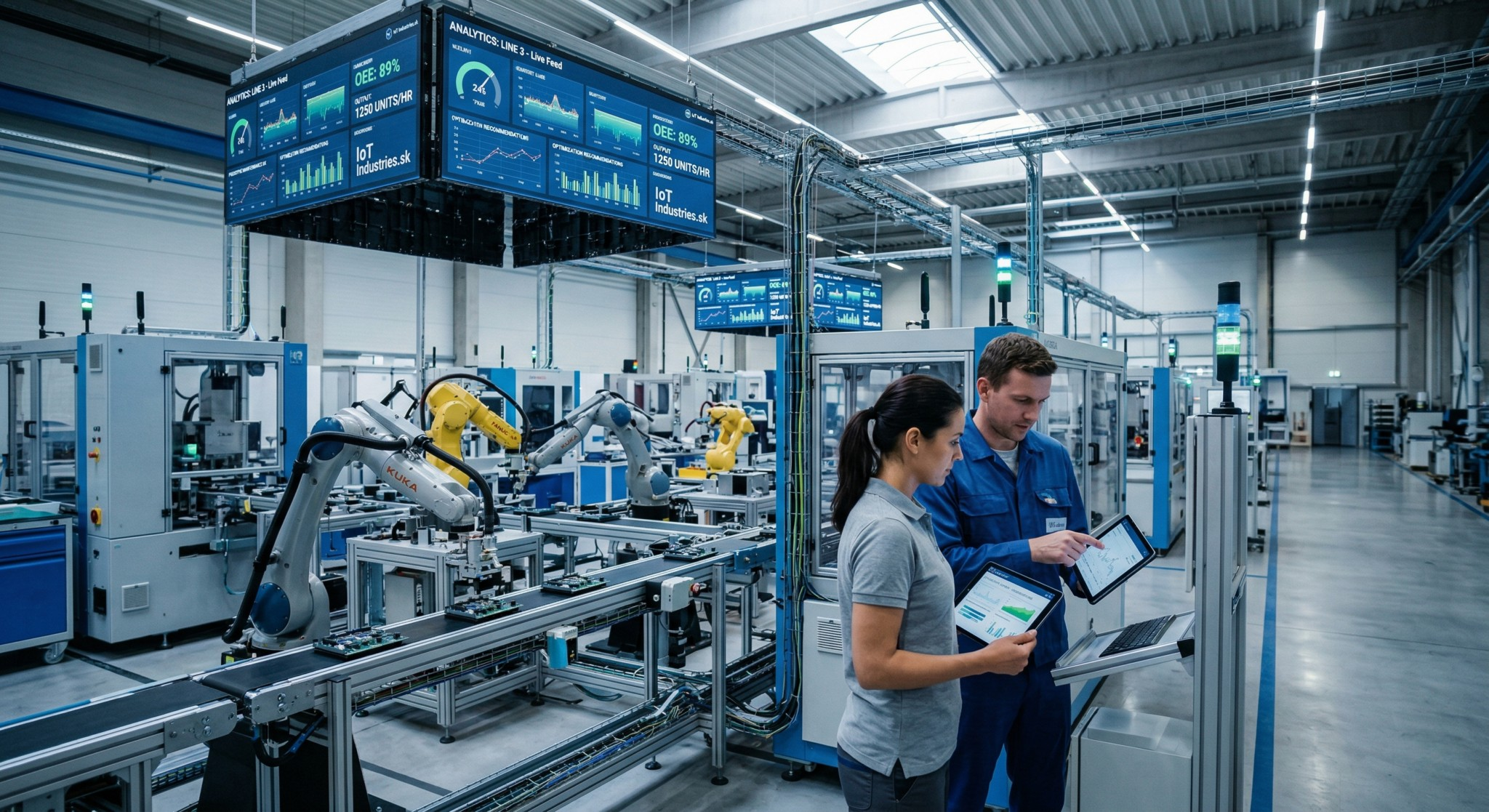
Industry 4.0: What is it and why does it matter?
The concept of Industry 4.0, also known as the fourth industrial revolution, represents a fundamental shift from isolated automation to a fully interconnected digital ecosystem. While the previous stage introduced computers and PLC systems into production halls, i 4.0 goes one step further, where data, machines, and systems are integrated into a single intelligent ecosystem.
The Industry 4.0 concept is therefore not about purchasing a single specific software or technology. It is a comprehensive management philosophy where Operational Technology (OT) meets Information Technology (IT). The goal is to achieve a state where production is not optimized retrospectively based on reports, but continuously and dynamically according to the current situation on the production line.
The foundation of an Industry 4.0 Factory is the integration of:
- production equipment (OT – Operational Technology),
- enterprise information systems (IT – Information Technology),
- automated data collection,
- data analytics
- and intelligent control.
Historical context: When and how did it all begin?
The starting year of Industry 4.0 is officially considered to be 2011, when this term was introduced at the Hannover Messe trade fair in Germany. Since then, it has evolved from a national digitalization strategy into a global standard for every modern factory 4.0, built on four historical pillars of development:
- First industrial revolution – mechanization of production using steam
- Second industrial revolution – electrification and the introduction of assembly line production
- Third industrial revolution – automation using electronics and computers
- Fourth industrial revolution (I 4.0) – digitally interconnected, data-driven production
Industry 4.0 automation pyramid
A key architectural element of the entire concept is the Industry 4.0 automation pyramid, which illustrates the hierarchy of production control. The difference compared to the past is that these layers no longer operate in isolation. I 4.0 connects them into a single data ecosystem, where information flows bidirectionally and in real time.
- Field level – devices and sensors that collect data directly from machines
- Control level – control systems and PLCs that ensure local control
- Supervisory level – SCADA systems that monitor production in real time
- Planning level – MES systems that connect planning with real operations
- Management level – ERP systems that provide a strategic view of production
- Business Intelligence and advanced analytics
Industry 4.0 technologies and their benefits
If we look at Industry 4.0 only as a technological trend, we miss its true meaning. The real value is not delivered by the technologies themselves, but by their practical implementation. The ideal outcome should therefore be a Smart Factory 4.0, where production operates based on accurate, real-time data.
1️⃣ IoT and IIoT (Industrial Internet of Things)
The foundation of Smart Factory 4.0 lies in IoT and IIoT technologies, which ensure automated data collection directly from machines, production lines, and equipment, thereby creating a reliable foundation for the entire digital transformation. The company no longer has to wait until the end of a shift, manual reports, or retrospectively completed spreadsheets, but instead works with reality as it happens.
2️⃣ SCADA (Supervisory Control and Data Acquisition)
These data are then processed by SCADA systems, which enable real-time monitoring and control of production. As a result, production is no longer a “black box.” Management has instant visibility into everything that is happening. Instead of waiting for reports, they see problems as they occur and can respond immediately.
3️⃣ MES (Manufacturing Execution System)
Smart Factory 4.0 also fundamentally changes the way production is planned. The integration of production with MES eliminates the gap between plan and reality. Production is no longer just an executor of plans, but a dynamic system that can adapt to current conditions.
4️⃣ OEE (Overall Equipment Effectiveness)
One of the most significant benefits of Smart Factory 4.0 is the ability to increase productivity without the need to invest in new machines. Accurate performance measurement (using OEE) often reveals that production operates at only 50–60% of its potential. By eliminating hidden losses, it is possible to achieve a significant performance increase without capital expenditure.
5️⃣ CMMS (Computerized Maintenance Management System)
These insights are further supported by maintenance management. CMMS systems enable a shift from reactive maintenance to planned or predictive maintenance. Machines are no longer repaired only after they fail, but interventions are carried out based on their actual condition. This allows companies to reduce the risk of unplanned downtime and extend the lifespan of equipment.
6️⃣ EMS (Energy Management System) and BMS (Building Management System)
Energy efficiency also plays a significant role. In a Smart Factory 4.0 environment, energy consumption data is integrated with production processes, enabling optimization of consumption without negatively impacting performance. Companies thus gain not only lower costs, but also better readiness for ESG requirements and future regulations.
7️⃣ Business Intelligence
At the top of the entire ecosystem is Business Intelligence. Tools such as Power BI transform all this data into clear dashboards and provide management with a clear picture of company performance. Smart Factory 4.0 is therefore not about having more technologies. It is about production finally being managed based on reality, not assumptions.
However, the key is not the ownership of technology itself. What matters is how these tools are interconnected and whether they work with high-quality data. Once your production stops relying on assumptions and starts relying on reality, Smart Factory 4.0 will bring these key benefits in practice:
- ✅ Greater production flexibility
- ✅ Better cost control
- ✅ Higher productivity
- ✅ More accurate planning
- ✅ Increased competitiveness
Industry 4.0 – real-world examples
To prevent the Industry 4.0 concept from remaining purely theoretical, it is best to look at specific real-world examples. Real projects clearly demonstrate that digital transformation in manufacturing is not about more technologies, but about better data, greater transparency, and the ability to make faster and more accurate decisions.
➡️ One such example is a pilot OEE project in Slovak automotive production, where the company needed to verify whether it was possible to implement digital performance measurement even on older equipment. Before implementation, part of the production relied on paper forms, Excel spreadsheets, and manual data entry into SAP, which was slow, inaccurate, and practically did not allow real-time data analysis.
After implementing the solution, the company was able to collect and evaluate dozens of machine parameters in real time, measure availability, performance, and quality more accurately, and significantly improve visibility into the real causes of downtime. The result was highly convincing. Within just a few weeks, productivity increased by 20%, average OEE rose from 56% to 70%, and the number of units produced per shift increased by 25%.
➡️ Another strong example is a project at the ECCO Slovakia plant, where the key focus was material flow, coordination between warehouse and production, and eliminating picking errors. Before digitalization, production relied on paper plans, Excel spreadsheets, manual calculations, and personal communication between departments. This led to time losses, errors in material preparation, downtime, and process chaos.
By implementing an Electronic Delivery System (EDS), the company achieved a single source of information and significantly improved and accelerated material flow. Error rates in material preparation decreased by 20%, losses from missing components were reduced by approximately €25,000 annually, unnecessary movements and communication were eliminated, resulting in approximately 15% time savings per employee per shift, and total annual savings reached approximately €69,000.
Both of these implementations demonstrate the same principle. Smart Factory 4.0 does not arise from one major technological leap, but from gradually building an environment where data is available in real time, processes are transparent, and decisions are based on reality, not assumptions. If you want to explore the detailed progress of both projects, you can find them HERE.
Common mistakes in Industry 4.0 implementation
Many companies today consider implementing Industry 4.0, yet the results often fall short of expectations. The reason is usually not the technology itself, but the way digitalization is approached. What matters most is whether the entire project is built on clear objectives, high-quality data, and a realistic implementation plan.
❌ One of the most common mistakes is starting with technology instead of the goal. A company invests in a specific system without a clear understanding of the problem it should solve. The result is a technically functional solution that fails to deliver real value to production. If the company does not know its goal from the beginning, it is very difficult to expect measurable results.
❌ Another frequently underestimated factor is the quality of input data. If data is collected manually, inaccurately, or with delays, any analysis loses its value. Decision-making then once again relies on assumptions rather than reality. Smart Factory 4.0 is built precisely on the principle that companies work with accurate, real-time data.
❌ In practice, technical readiness of the environment is also often underestimated. Smart Factory 4.0 solutions depend on reliable network infrastructure, which is not always guaranteed in industrial environments. Production halls, metal structures, or remote locations can significantly affect connectivity quality, complicating the entire project.
❌ A separate chapter is IT security. Requirements for data encryption, device certification, or data localization are justified, but in practice, they slow down implementation. Without close cooperation with the IT department, the project can take months. However, if security requirements are considered already in the design phase, the risk of delays can be significantly reduced.
❌ Companies also often expect fast results without changing processes. However, Industry 4.0 is not just about technology, but also about changing the way work, decision-making, and production management are approached. A new system alone does not guarantee better results if no one learns how to work with data and if the company does not also focus on adjusting processes, responsibilities, and daily operations.
Step by step towards Smart Factory 4.0
Starting with Industry 4.0 does not mean implementing a complex solution across the entire company. The most effective approach is gradual, data-driven, and based on real production needs. This is why it can be suitable not only for large corporations, but also for small and medium-sized manufacturing companies.
🎯 The foundation is to clearly define your goal. The company should answer simple but essential questions: What do we want to improve? Do we want to reduce downtime? Increase production efficiency? Optimize energy consumption? Or gain better real-time visibility into production? Without this phase, choosing technology makes no sense.
🔎 This is followed by an initial audit and solution design. It is necessary to identify the equipment that will be integrated into the system, verify network availability, and determine which data should be collected. It is also crucial to think about the future. The solution should be scalable and ready for expansion with additional systems.
🚀 A very effective step is a pilot project (Proof of Concept). This allows verification of the solution on a smaller part of production, testing data quality, and obtaining the first measurable results. This step significantly reduces risk and helps set the right direction before full-scale implementation.
🔁 However, the project does not end after implementation. Daily work with the system is key. This includes employee training, regular monitoring of device functionality, verification of data accuracy, and continuous system improvement. Only then does Industry 4.0 become a tool that delivers long-term value, rather than a one-time project.
Industry 4.0 towards future industrial opportunities and challenges
Remember, Industry 4.0 is not a goal in itself. It is a way to gain greater control over production, eliminate unnecessary losses, and base decision-making on accurate data instead of assumptions. For some, it may start with measuring OEE on a single production line; for others, with digitalizing material flow, energy management, or maintenance. What matters is starting the right way. With a clear goal, a high-quality design, and a partner who understands both technology and real manufacturing.
At IoT Industries, we help manufacturing companies design and implement solutions that connect the OT and IT worlds into one functional whole. If you want to discover where the greatest potential lies in your production and how Industry 4.0 can work specifically in your company, contact us. We will be happy to explore solutions with you that make sense both technically and economically.
Why Choose IoT/IIoT Implementation with IoT Industries?
Traditional companies typically specialize in OT (operational technologies, such as production lines and devices) or classic enterprise IT systems. However, we are able to connect both of these worlds. Our unique expertise in integrating OT and IT allows us to deliver innovative solutions in digital transformation, enhancing efficiency, reliability, and competitiveness for manufacturing companies.
