
Many manufacturing companies invest heavily in modern technologies, yet the interfaces people work with every day often lag behind. Screens are inconsistent, each one looks different, colors have no clear meaning, and critical information gets lost in a sea of details. The result is higher error rates, lower safety, and unnecessary cognitive load for operators. The ISA-101 standard was created as a response to these issues. It provides clear guidelines for how industrial displays should be designed so they are understandable, easy to read, and help people in manufacturing make the right decisions at the right time.
What is ISA-101?
ISA-101 is an international standard that defines how human–machine interfaces, known as HMI (Human-Machine Interface), should be designed. These are the screens through which operators monitor production status, control technological processes, and respond to faults. In practice, ISA-101 represents a set of principles and recommendations for a consistent and understandable visual “language” that allows operators to immediately recognize what is operating normally and what is not.
Think of it like road signage. No matter where you drive or what car you use, traffic signs have the same meaning everywhere, so drivers don’t have to think about what they mean. ISA-101 works in the same way—just for industrial screens.
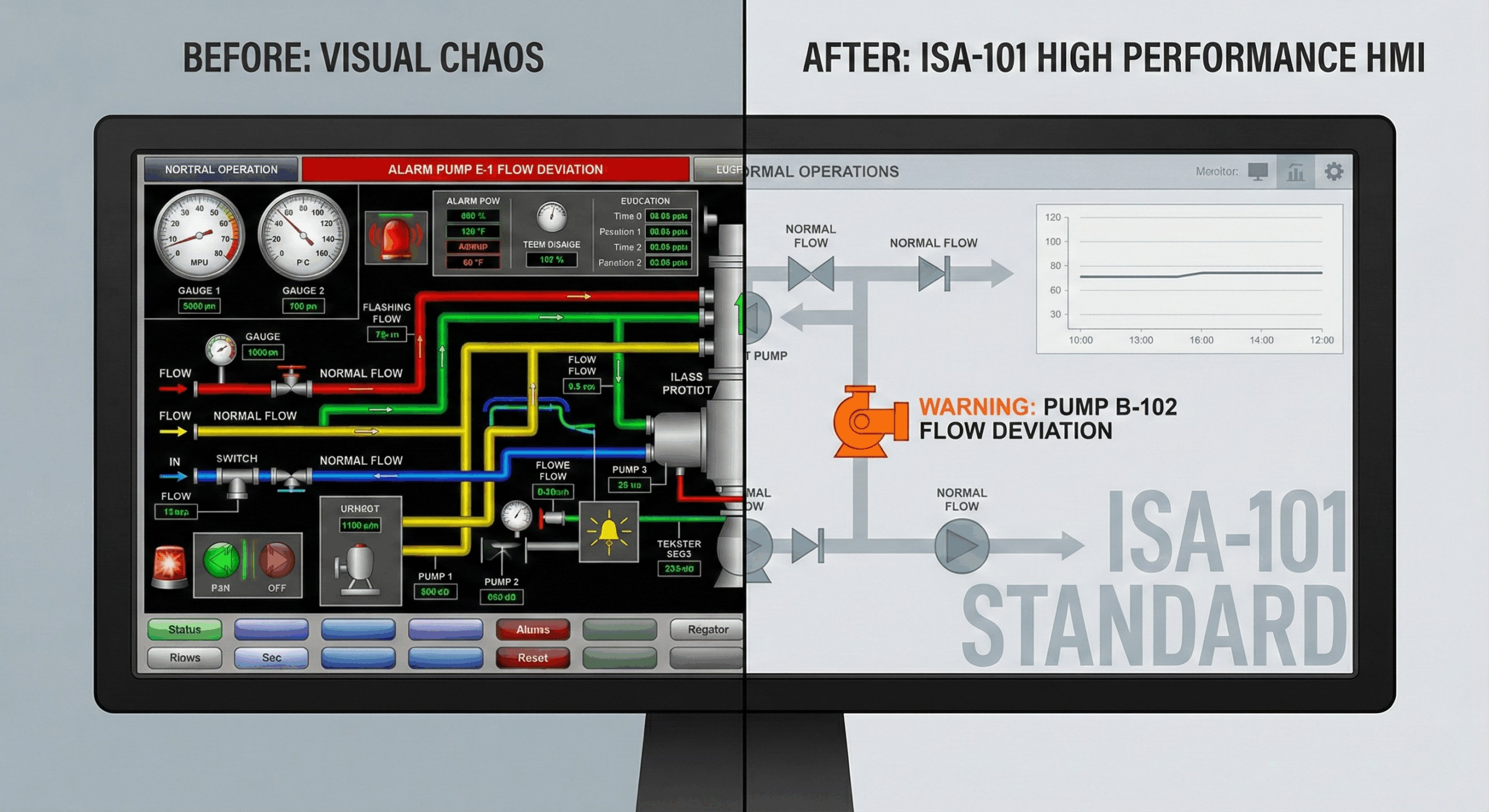
The goal of ISA-101 is to reduce clutter and chaos on screens. Instead of excessive colors, icons, and animations, it relies on simple and clear visualizations where every color or highlight has a clearly defined meaning. When something goes wrong, the problem immediately stands out and cannot be overlooked. In other words, ISA-101 helps people make fewer mistakes and respond faster.
The acronym ISA stands for the International Society of Automation, the organization that develops these standards. The number 101 refers to the specific standard focused on HMI design.
Why was the ISA-101 standard created?
The ISA-101 standard emerged from real-world experience in manufacturing plants. In practice, it repeatedly became clear how inconsistent and cluttered screens lead to errors, delays, and unnecessary stress in production. The problem was often not the technology itself or a lack of data, but the way data was presented to the people who worked with it every day.
Each screen looked different, colors had different meanings, and operators had to learn how to “read” each machine separately. Visual chaos—too many colors, icons, and animations—meant that everything on the screen appeared equally important. When a real deviation or issue occurred, it could easily get lost among other information.
ISA-101 was created as a response to these situations. It introduced clear rules for how information should be displayed so that it can be understood at a glance. The goal was not to create “prettier HMIs,” but interfaces that reduce mental load, shorten reaction time, and help people make the right decisions—even under pressure.
| Traditional HMI approaches | ISA-101 |
| Many colors | Minimalist, meaning-based colors |
| Animations | Simple, clear elements |
| Chaos | Consistent structure |
| Reactive problem handling | Prevention and fast situational awareness |
The High Performance HMI Principle
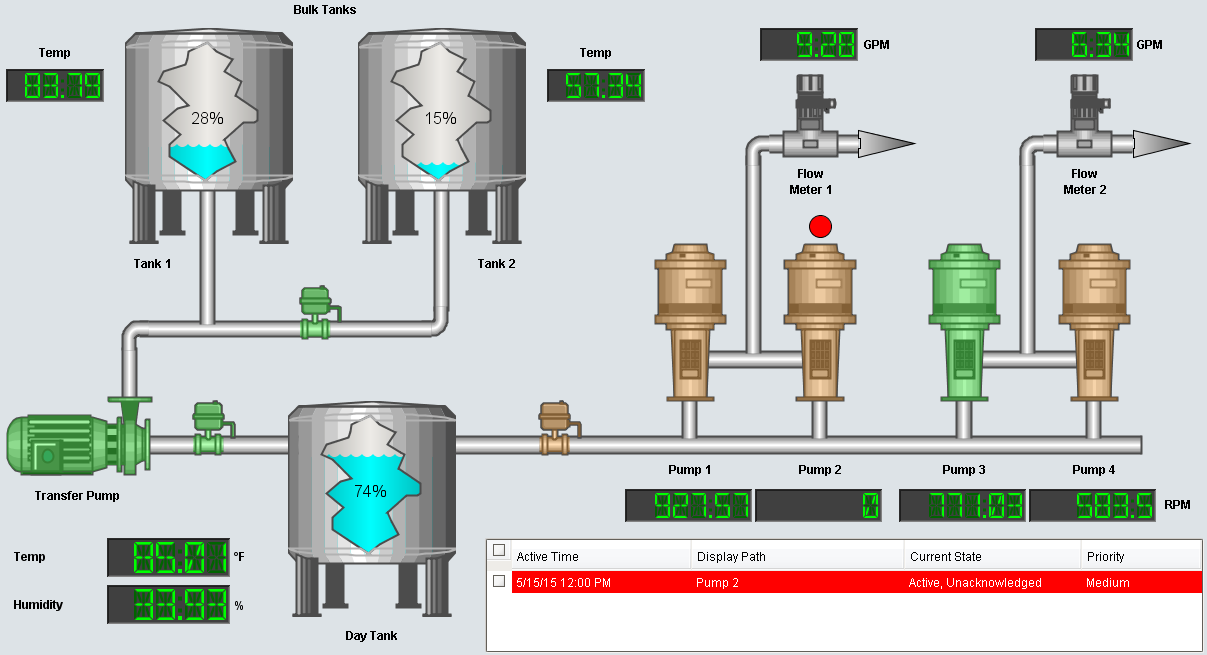
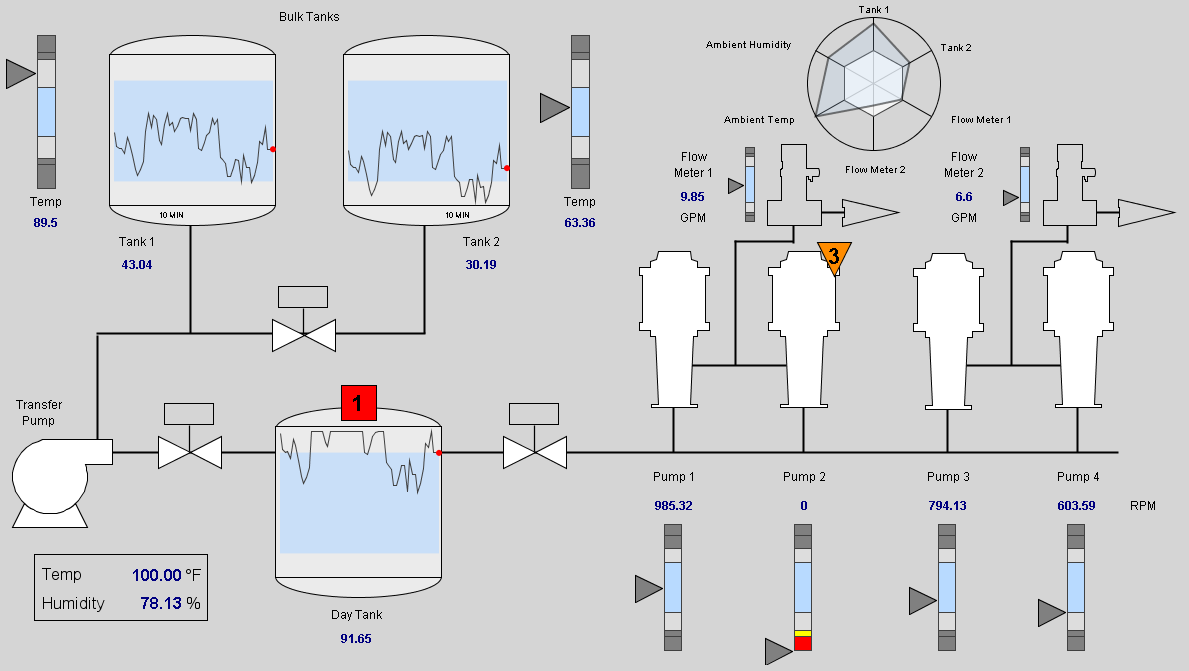
One of the key pillars of the ISA-101 standard is the High Performance HMI principle. It is based on a simple but often overlooked fact: the human brain has a limited capacity to process large amounts of visual information at once.
High Performance HMI therefore changes the way we think about HMI design. The goal is no longer “to display everything”, but to display what truly matters, in the right way. The normal operating state of a process should be visually calm and unobtrusive, so operators do not have to constantly monitor every detail. In contrast, deviations, faults, or risky conditions must be clearly and immediately recognizable, without searching or overthinking.
A crucial role in this approach is played by ISA-101 color usage. In High Performance HMI, colors are not decorative—they are signals. Gray and neutral tones represent the normal state, while yellow and orange indicate warnings and deviations. Red is reserved exclusively for critical conditions. This ensures that each color has a clear and consistent meaning.
ISA-101 also takes into account a real-world factor that is often overlooked in practice: color blindness. Approximately 8% of men suffer from some form of color vision deficiency, which means such operators are commonly present in manufacturing environments. For this reason, ISA-101 does not rely on color alone to convey meaning. Critical states and alarms are also supported by shapes, symbols, and clear visual elements, ensuring information is understandable to everyone, regardless of their ability to distinguish colors.
Equally important is the hierarchy of information. High Performance HMI works with multiple screen levels—from high-level overview screens down to detailed views of individual devices. The operator first sees where a problem is occurring, then what is causing it, and only then how to resolve it. The interface guides the user logically and systematically, instead of overwhelming them with information.
What Are the Practical Benefits of ISA-101?
The result of applying ISA-101 is an HMI that supports so-called situational awareness—the ability to quickly understand the current state of production, its development, and potential risks. Operators are not forced to constantly “read the screen”, but react only when necessary. This reduces mental load, shortens reaction time, and significantly minimizes the likelihood of human error.
From a business perspective, ISA-101 High Performance HMI also delivers long-term benefits. New employees can be trained faster, operator substitution between production lines becomes easier, and technology changes can be implemented without introducing visual chaos. The HMI thus becomes a stable and reliable tool that grows together with the production system.
Companies that modernize their HMI according to ISA-101 gain:
- faster operator response times,
- lower error rates,
- higher safety,
- better use of production data,
- readiness for the next steps of digital transformation.
Where to Get the ISA-101 Download?
The official ISA-101 download is available on the ISA organization’s website. It is a paid document that includes detailed HMI design rules, recommended practices, screen examples, terminology, and methodology. For serious projects, working with the official documentation is essential—especially if the goal is long-term sustainability of the solution.
How Does ISA-101 Fit into Industry 4.0?
Industry 4.0 brings enormous amounts of data into manufacturing. However, data alone is not enough. If people cannot see it in a clear and understandable form, it remains just numbers hidden in systems that are not effectively used in practice.
This is where ISA-101 plays a critical role, because it ensures that information from SCADA, MES, OEE, EMS, and other systems is presented in a way that operators and management can immediately understand. Thanks to a consistent and clear HMI, data from digital manufacturing is transformed into fast decisions and concrete actions, not just additional reports.
At IoT Industries, we therefore do not see ISA-101 as a standalone “HMI topic”, but as a natural part of digital transformation and Industry 4.0. When designing solutions, we focus on ensuring that screens are not only technically correct, but also readable, consistent, and usable in real operational conditions. The result is a production environment where technology, data, and people work together as one.
A Comprehensive, Tailor-Made Solution from IoT Industries
At IoT Industries, we do not approach ISA-101 only from an implementation perspective. We are also actively involved in its development as members of the ISA-101 committee, which contributes directly to the creation and evolution of this standard. This means that we understand exactly why individual principles were created, how they should be applied correctly, and where the standard is heading next.
Thanks to the combination of international standards, real-world operational experience, and active participation in their development, we are able to design HMI interfaces that are not just “compliant with the standard,” but truly effective in everyday manufacturing operations. If you want to elevate your HMI interfaces to a professional level and prepare your production for the future, get in touch with us. We’ll be happy to show you how ISA-101 works in practice.
